


Epitaph
- Asiimov Baker

- May 23
- 8 min read
Walking up a gravel slope, my path was suddenly barred by something invisible but concrete. Under the spell of ancient stone, I looked up at the four matrons who carried the weight of the building on their heads. The April sun fell across their faces like a golden veil, as supple as their billowing gowns hewn right into the rock. Their hard eyes measured me with… caution? What was I supposed to be cautious of? Why am I over-analysing the inscrutable eyes of a statue?
Ultimately, they weren’t interested in me… yet. For when the time comes to sling my mortal coil, I’ll become their responsibility. They’ll watch over me and scare off any of my enemies looking to piss on my grave.
My fantasy was floored by the fact that this place hasn’t been used as a burial site since 1854. My remains would have to be someone else’s problem. These maidens of stone, turned emerald from rain, already have enough souls to guard. Bowing for their leave, I made for the rusted door that led down into the crypt below their feet.
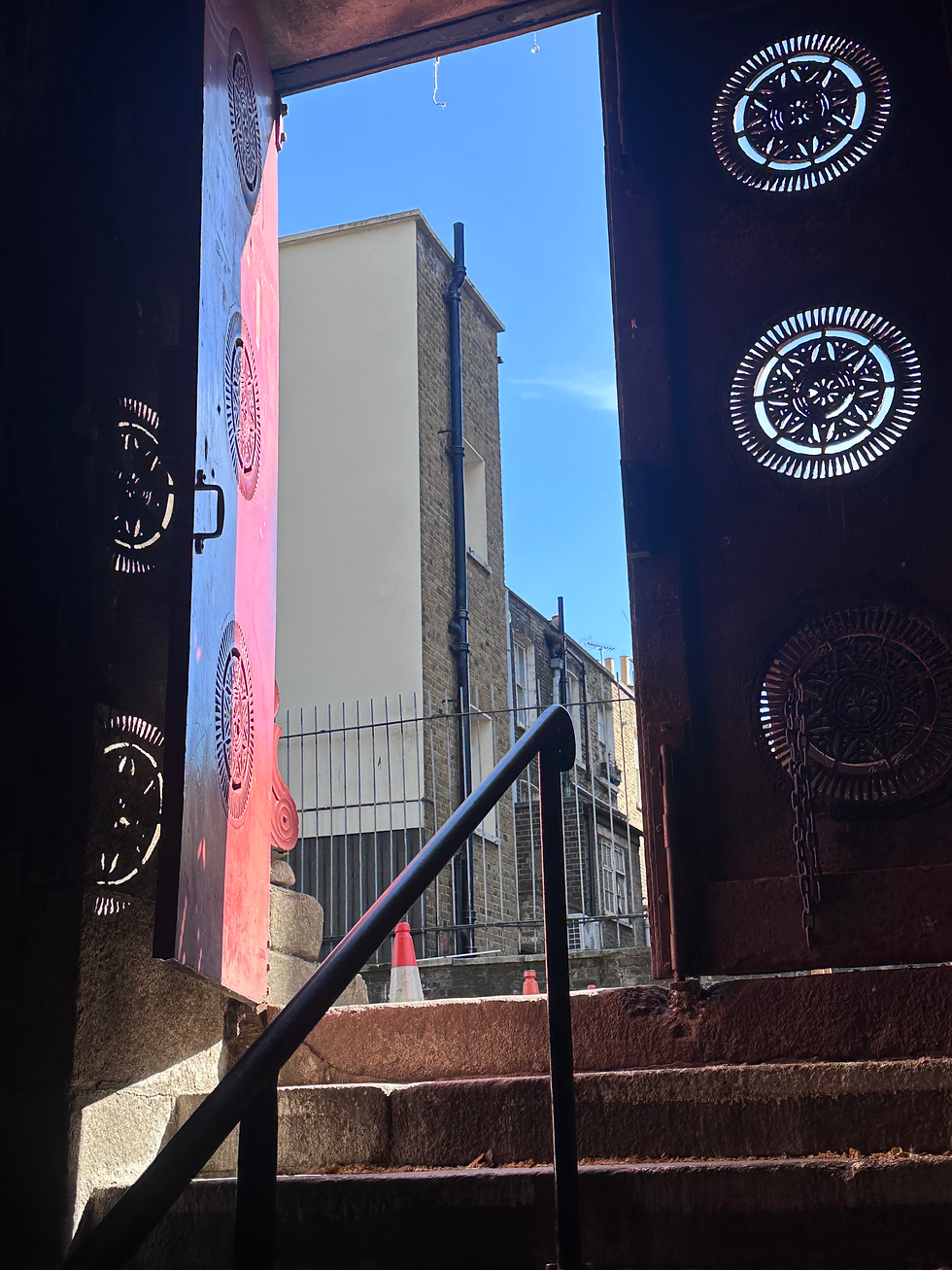
Descending the steps I rubbed the sun out of my eyes. Once they adjusted to the underground gloom I spotted a puzzling sight. A skull sitting ceremoniously on a plinth, it’s cranium overflowing with little handwritten notes. “The Skull of Golgotha”, declared a sign written in sharpie on an A4 page, “Place a name in the skull. Forgive them xx” I picked up the pencil and began writing the name of my bitterest enemy. There’s an endless queue of sinners waiting to be forgiven, maybe it’s about time I help it along. I was halfway through writing their name, feeling like a stand-up guy, when from around the corner an apparition appeared.
“Oh hey Nols,” I said upon recognising the spectre who floats around in grievous determination. A black overcoat descends from his thick, felt fedora.
“Asiimov. Thank you for making it, how are you?” he went in a deep, heathery baritone.
I know Nols Nathanksi from around the London poetry scene. Though he’s only been performing since March last year, you’d think he’s a seasoned veteran with the way he and his words carry themselves. In the all-black uniform of an undertaker, he stalks the stages like a restless spirit fulfilled a thousand times over by a single lifetime. Harshly intimate words come sliding out of his angular jaw and his black-lined eyes reach out and take you in with a tender embrace. There’s no one I can think of who dislikes Nols and whoever does needs to get their head checked. So when he announced a poetry festival – in the crypt underneath St. Pancras Church, no less – poets on the scene flocked towards it. No journalists though.
“I didn’t hear from any of the other journalists I sent out press kits to,” he said with a bit of chagrin.
“Don’t worry Nols, you’ve got me,” I consoled, “The crème de la crème of the bottom of the barrel.”
After some chit-chat, he swanned off - disappearing into some subterranean backroom to record an episode of his podcast, Make Poetry Weird Again. But not before pointing me towards the tea station. A cuppa with soy milk (sadly the only kind they had) in hand, I looked around the place.
The festival, called Hold Space, was on for a week from the 1st till 7th of April. Holy week fell through most of it. I turned up on day six, a day after my birthday on Easter Sunday. Resurrection day. Although there wasn’t much left to resurrect after the party. Anyway, for the duration of the festival a cohort of resident poets created work, attended workshops, and hosted open mics every evening. A zine was printed and distributed at the end of it. Venturing deeper into the crypt, it took me a moment to get used to the shift in atmosphere. It was so very quiet, there was nobody not a soul around. No live ones at least, for the place holds the remains of 557 people. Their presence hums silently through the brick walls, bathed in warm gallery spotlights. Shadows fell like blades on the floor. The sound of traffic on Euston Road above was displaced down to a distant ambience. I felt cradled by these meandering corridors wrapped around me.

Each resident poet had a little corner somewhere in the space where the accumulation of their work throughout the week would spread across the walls like spores. Some were more forthcoming than others. Some featured only strange artefacts rather than words. But I found myself studying every detail all the same.
H Philips - who I spotted later wandering around in a voluminous blue wearable blanket - had a collection of typed and handwritten poems pinned to a wall. Whether it’s about kisses at the end of emails, the contents of a woman’s bag, or the stoic perseverance of self-service check-out staff, her poetry distils poignant observations of the mundane.
I was drawn to a proliferation of photographs spreading across a wall, chronicling the life of Kristal Sisodia. A somewhat linear passage through their family and heritage brings us to the present moment; their child cradled in their arms. Their older brother Raj, however, holds a special place in their heart as their first published poem – sitting on a plinth like a piece of history – is an ode to his steely presence in their life.

In an alcove there hung a book with honeycomb pages. Steel wire and silky black locks of hair held the whole thing together. Sheafs of old parchment were threaded through; their words I could not understand. This is the work of poet/witch Byuka Makodru. On a wall next to this unwholesome tome was what looked like sheet music. Distended to dragonic proportions, these symbols only vaguely resembled the real thing. Clefs and staffs and notes and measures of black and red fly across the page, fine as a hair sometimes while dangerously loud at others. I can’t read sheet music but I’m convinced that whatever this is will make my ears bleed. Yet I yearn to hear these horrid sounds.
I rounded a dark corner into a short corridor where tombstones were stacked against both walls. A shrivelled rose rested on one of them. Why are they separated from their accompanying graves? Clearly memorials aren’t immune to time. This odd sight stayed with me as I continued walking around the tunnels. Whether they know it or not, these poets are busy penning their own epitaphs. Even though I’d see many of them at the open mic later, I couldn’t help but imagine each poet’s corner as the last trace of someone dearly departed.
My path was stopped by a black blast door, a remnant from when this place was used as a bomb shelter during the Blitz. A gas mask lay ominously on the floor next to an artwork I knew was made by Nols. This gaunt portrait was rendered in his distinctly hurried style; frenetic and vulnerable outlines around a painfully indifferent face.

The open mic wasn’t on for another hour and a half so I decided to walk back home for some spicy peanut butter noodles, a joint, and a pint of flat Prosecco. I convinced my friend and then-housemate River to join me for the rest of the evening so she turned up in a magnificent floral mesh dress over black jeans. Chairs were being re-arranged around the crypt when River found herself beckoned by Byuka’s otherworldly sheet music.
“This make any sense to you?” I asked her expertise in such matters.
“I can read this! Not entirely but bits of it,” she said in awe.
“What do you hear???”
She was about to reveal to me the nature of this sound when a softly accented voice over the microphone invited everyone to sit down. It was resident poet and our host for tonight, Pia Fajelagutan. Reflecting on all they’ve done so far throughout the week, she thanked Nols; their friend, mentor, and cult leader. The leap from performing at poetry nights to facilitating a week-long festival was a prodigious one which came with its own set of creative responsibilities. Nols’ instinct is to create rather than hold the room for other people’s work but he quickly realised that shaping the conditions rather than the content is its own act of creation. This also included leaving the space entirely from time to time and letting the poets just get on with it. No one likes a hoverer.
Pia was taking names from people who wanted the stage to share their words. Nols sidled up to me in a cape and staff, asking if I’d be signing up. I’ve never written anything that can be read in less than five minutes so I said no. The open mic-ers came on one after another and I must admit I don’t remember a thing they said. The quality of their poetry has little to do with it. It’s hard to recall words unaided a month and a half later – and I don’t do literature reviews. But I distinctly remember the vibrations in the room and how their words hung restlessly in the air, resisting their own fading. The only time you won’t get applauded at a poetry reading is if you go up on stage and say something problematic. I say this to demonstrate the truly warm and inviting culture prevailing at these readings. But it does mean that most of the poems simply occur rather than happen to you. It can be too easy for the reader, and even easier for the listener. Nols puts it most effectively, “I wanted people to leave having been asked something rather than having been given something. Poetry to disturb the comfortable and comfort the disturbed.” In that sense, he wanted to cultivate restriction; for the poets to dislodge something from within themselves and be as surprised as the audience as to what comes forth. Fingers were snapped and murmurs of astounded approval quivered often through the crowd.
The lights went down, replaced by a projection which turned the wall into rippling water. Everyone’s attention was on the two figures cloaked in shadows; vocalist Lara Eidi and keys player Valerá Symonchuk. Twinkling notes rose from the keyboard and were wafted along by Lara’s canary call. Together they sounded like the sighs of the earth, resounding through a network of subterranean tunnels until amplified to a staggering volume. They bid everyone to their feet and follow them up the steps and outside under the black, smoke-streaked sky. We all held hands and hummed. To those who’d been here since the first day, this felt like a momentous ritual. There was fervour in their closed eyes. I, on the other hand, only felt a sixth of their zeal.
I asked Nols about his definition of holding space and I still to this day think about his answer. “To be present with someone without trying to fix or resolve what they’re carrying. To make the conditions in which something difficult can exist without being collapsed into something easier. Coming as you are and accepting what comes with it.”
As a frothing-at-the-mouth control freak, I find it difficult to accept that not everything has to be fixed immediately. Sometimes the sting of strife must be felt before it can be fought. Nols calls the mic a fail space. Simply getting up there is making the work. Accepting that your fate could go either way. An exercise in failure. But that’s fine, because the audience will hold you to it, and you will hold it to them.
All I can really say is that all those journalists who never replied to Nols really missed out.


Comments