


Ribbons of Flesh

It was rush hour and a swarm of cyclists were pedalling up and down Theobalds Road. Unleashed on the asphalt with each green light, they’d go flying down intersections, following closely by motor traffic that seemed timid in comparison. I’m in my bike era without a bike. Still trying to figure out where the hell I’ll even store the thing, I’m holding off from getting one. In the meantime, an abundance of them is being rubbed in my face. Every Lime or Pendleton or Swapfiets or kid’s tricycle that glides past me tugs at my longing for wheels.
I then realised I had arrived at Mimosa House where I was invited to the opening of Nuliaminik Neqilik. This is the solo show of Inuk (that’s singular for Inuit for those who – like me – didn’t know) artist Laakkuluk Williamson. As someone with an anti-colonial inclination, her work interests me because it embodies many things within the nebulous cloud of personhood and belonging. Especially since her home is under threat. A schizophrenic president threatens to indulge in his favourite hobby of land-raping and suddenly the whole world notices Greenland properly. But what do most of us in the west know about Greenland?
A cascade of ribbons covered the windows of the gallery in luminous pinks, purples, reds, blues, and white. Couldn’t see anything inside past this curtain to another world. Walking through the front door and I was… in yet another private view. I got a glass of white wine from the table which I swirled around, feeling awfully fancy. I don’t even like white wine. If only this was a mimosa. Anyway, more ribbons. Coiled all over the floor, I had to watch where I stepped. Although later the place would get busy and the people bold enough that they were straight-up feeling the ribbons with their hands and moving them about.

Three incredibly long strands which found their source in three objects suspended from the ceiling. They had the appearance and aura of something ancient; a corpulent doll, a comb, and a needle. These sculptures recreate Inuit artefacts currently held in the British Museum (surprise!) down the road, things used and made by women. If the femininity of this ensemble is in any dispute, then simply look down at the log placed upon bed of twinkling black dust. Small beads of fleshy pink are strung together into what looks like a vulva, fitting perfectly in the contours of the wood. With another ribbon emerging out of it for good measure. See, this one throws me off because the ribbons tied around the artefacts could be taken for the link between indigenous communities and the possessions looted from them. But what of the ribbon coming out of a vagina on a log of wood? It’s no secret that misogyny exists across a vast spectrum of cultures and that women are often the harshest victims of colonialism – subjugated and sexualised. But there’s a quiet rebellion in this piece, of the same flavour as setting up an anti-colonial exhibition right on the British Museum’s turf.
I squeezed my way through to a darkened room where a film was being screened on a curtain of white ribbons. Of course. The shot was split in three, each third featuring the artist in a hostile tundra at different times of the day. Hair flowing down to her breast and countless long ribbons tied around her wrists was her only insulation. An upsetting dirge was playing over the soundtrack. She swayed with a purpose. Like ripples, her movement in one panel were responded to by another. Nuliaminik Neqilik translates to “the flesh of wives”, taken from the old Greenlandic folk tale of Igimaarasussuaq who had a taste for cannibalising his wives. The idea of becoming food didn’t appeal to his last wife Masaannaaq who exacted revenge against him. As the namesake piece of the show, I got none of that from watching this – apart from a few vague mentions of “filling the room”. Maybe it’s my hatred for video works… The ribbons around her wrist stuck out to me though, making me imagine all the artefacts of her culture that are still tethered to her from the distant lands of looters. But what about trough of water on the floor from which more ribbons emerged like wet tendrils? What does that represent? My thirst, evidently; so off I went to get another drink.
Oh god not another one, I thought while walking into another video work. This one, however, was projected onto the hide of a polar bear stretched with rope across a frame. Not a real polar bear hide though – I don’t think that would’ve gone down well with the animal rights activists. The film featured Laakkuluk in traditional Inuk garb stood next to the skull of, presumably, a polar bear. An actual confrontation with the animal at her family cabin in Nanavut served as the impetus for Nannappugut! which translates to “we killed a polar bear.” The appearance of this majestic bear is seen as a gift to the Inuk hunter, provided they survive the encounter. So to honour the animal’s spirit, Laakkuluk is dispatching it with a small drum. Moving to its syncopated beat, there’s a sharp smile on her face and respectful triumph in her eyes.

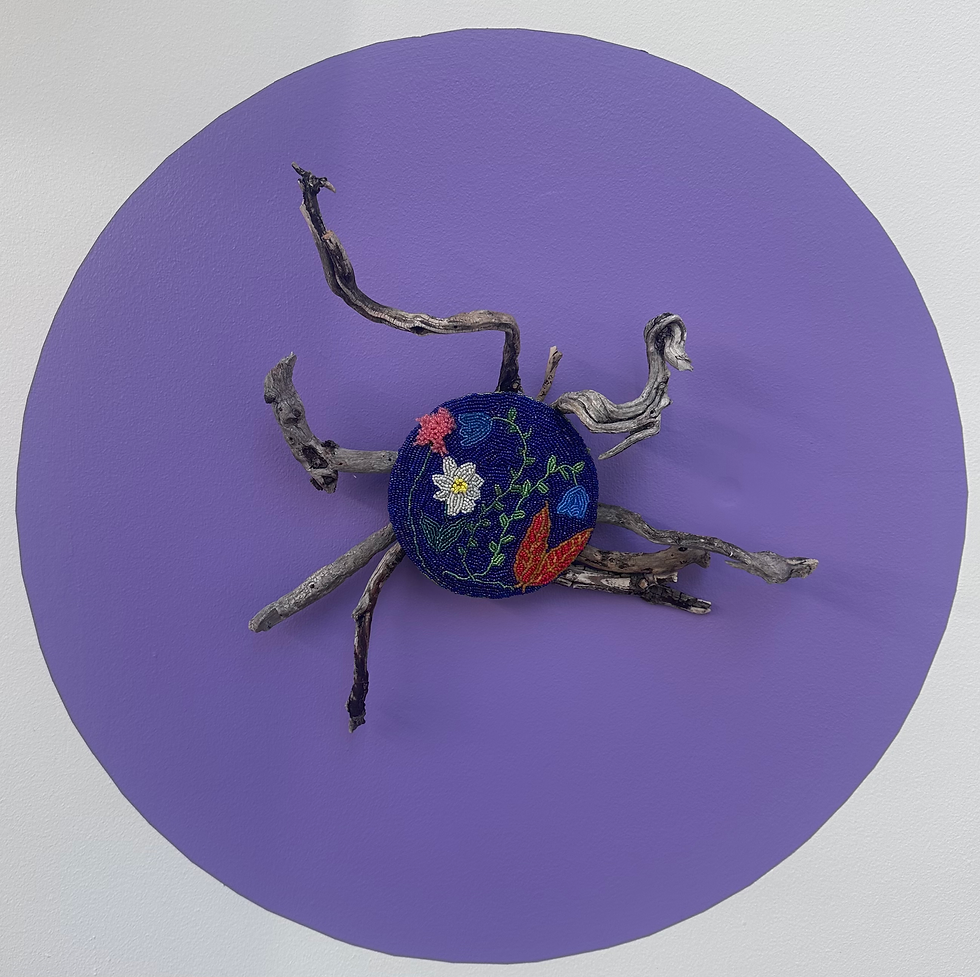
Right outside was something resembling an altar. The wings of a goose were gracefully spread as if about to take flight, and underneath there was a roundel made of goose feet. We’re talking real animal remains now, enough to wrinkle the brow of the staunchest vegetarian. A colourful image made out of beads adorned this leathery amalgamation of webbed feet. What initially looked like snakes turned out to be geese with their necks intertwined. This tender altar is part of a series called Niriqatigiitta!: Eating from the Multitudes which continues into the next room. Similarly wholesome images are beaded onto materials harvested either from animals or the land. And in each case the scene has something or other to do with the thing it’s occurring on. In a culture that aims to live harmoniously off the environment, these remains are somewhat exalted by Laakkuluk’s artistic process. Something which she does collaboratively with her children, stringing together tiny beads of glass in a meditative manner and trying to comprehend how the earth cradles their lives.
I was then confronted by an odd scene occurring across the wall behind me. Two figures standing on a rock, their vantage looking out upon a freezing land that’s vast and desolate and rich with opportunity. The man in white with his back towards me is the nitwit who hauled shiploads of worthless rock across the Atlantic thinking it was gold… Next to him was the person who gave him her blessing to do that. She waved a terrifying banner of black and red that flashed threateningly against the virgin snow. Martin Frobisher had the ear of Queen Elizabeth I which made it very easy for him to get his hare-brained schemes funded. While looking for the North-West passage which connects the Atlantic and Pacific Oceans through the Arctic Canada, he stumbled upon a huge deposit of gold. 200 tonnes of the stuff was brought back to England and despite the uncertainty of whether this was really gold or not, Frobisher managed to get another voyage bankrolled. This time he brought back 1350 tonnes. Once the smelters got working on the ore, the bankrupting realisation soon dawned on everyone who’d thrown money at this venture. It was hornblende, not gold. Simultaneously, from one of these voyages, Frobisher trafficked a family of Inuits back to England where they soon died from diseases which they had no immunity for.
White Knight and the Known Shore: Frobisher and the Queen is a still from one of Laakkuluk’s performances. The dark rock beneath their feet is flecked with a rusty gold. A miasma of greed emanates from their manner. Their senses lost to a colonial fever, deluded that every frontier is their birthright.
For someone who’s so active in her artistic community, it’s a surprise that this is Laakkuluk Williamson’s first ever solo-show. But since when was the mainstream art world known for giving a fuck about indigenous artists? So I’m glad Mimosa House have helped fill in the blanks. As an ever-increasing number of people are having their voices silenced, presenting the work of the those who go unnoticed or are ignored keeps them in the conversation. As long as they know that you haven’t forgotten, they haven’t won.



Comments