


Home is where the hatred is
- Asiimov Baker

- Oct 11, 2025
- 9 min read
Home is where the hatred is
Home is filled with pain
And it might not be such a bad idea if I never
If I never went home again
This exhibition is what I imagine the narrator in Gil Scott-Heron’s song would find if they indeed went home again. I don’t know what I was expecting when I visited Home, Troublesomely Ease Me Out: A Modern Nomadic Melodrama, but it certainly wasn’t this! Finding the place presented difficulties because group shows usually don’t take place in destroyed houses. When I finally did arrive, I paid my respects to the invigilator of the show; a black-and-white cat loafing on the windowsill.
Walking through the front door wedged open with a brick, I was immediately assaulted by an air of decay. No longer wanting to be a part of the walls, paint and plaster peeled en masse; replaced by artworks. Floorboards creaking with each footstep, the whole house groaned – as if alive - under the weight of the visitors moving through it. Reinforced beams peek through holes in the ceiling. Entire walls are missing. The back-alley ambience of a crack den pervaded every room. The structural fragility of the place reflects the curators – Yuan Zhang, Jiqui Zhang, and Lu Wang’s – vision of home; a fleeting and unstable place.
As far as alternative exhibition spaces go, Safehouse 2 in Peckham is quite jarring; because cool though it is that you’re at an art show in a dilapidated house, the environment sometimes absorbs the pieces so they’re easier to miss among the visceral surroundings. But it’s only right to do a show about home here.
With a paper cup full of red wine, I wandered through the musty halls and rooms. The artworks collectively felt like the half-forgotten memories of countless people passing through a single place. They overlap each other as the accumulating evidence of past habitation. Home is a place we find ourselves helplessly drawn towards, even though it’s a castle built on sand. What is home to someone running away from it? What is home to a person living in the land of their former colonisers? What is home to a person barely able to afford it? We all carry a notion of this place with us, influenced by every breath and step we take. This messy collage of emotions and experiences is the central message of this show.

The windows are completely bricked up and stained with soot. As I strained through the darkness of the unlit front room, looking at Tobias Carlton’s quartet of paintings felt like eavesdropping on a tense conversation between the grownups through a crack in the door. Innocence and fear get tangled up in those stern, pink faces and empty eyes. The lavish applications of paint create furrows of stress across their expressions. Their frantic manner of drinking and smoking gives nothing away. Their terse tone gives you all the meaning behind this conversation which their words don’t. One of them looks in your direction and you sprint light-footed up the carpeted stairs and back into bed before you’re caught.

Insidious vibrations continue through Cristián Fernández Ocampo’s uncanny paintings. A silhouette of red light slanting out of a lamp is about the only illumination this lightless room gets. Its counterpart painted in green is in the front upstairs. And at the top of the termite-eaten stairs is a tall, upside-down rose. Silhouetted black and thorny against red flowing from all the people pricked by it. The bold, impressionistic edges and the manipulation of artificial light lend these objects an unsettling significance, like a random detail from a harrowing scene that worms itself deep into your brain.

Adjoining the front room where an abundance of jaundiced lighting filtered through the windows, an acrobatic sculpture takes up most of the space. Dismembered and hollow limbs of rice paper are suspended from the ceiling and connected by this twirling strip of bamboo. It’s a whole choreography encapsulated in a single move. The artist Ya Shu was joined by Alice Herzog in a dance which I regrettably wasn’t around to witness. But the headless effigy laying lifelessly on a heap of bamboo certainly witnessed it. These human forms devoid of an identity might be how a house perceives us; complicated shapes moving through its embrace.
All this talk of the perception of a house makes me wonder whether we’re not dealing with a living, breathing thing here? Many of the artists in this show are depicting home as the soul which occupies the house like a body. A body that hungers and craves.

In the same room as the limbs suspended in a vacuum, something bizarre is on the wall. I was simultaneously repulsed and drawn by its membranous texture, this fleshy recess that… is it breathing?! Its wrinkled surface wheezed up and down like the chest of a dying person, assisted by the timed contraption it was hooked up to. Ruilin Fu’s attached this house to life support. Despite its grotesqueness I shared in the serenity this thing was finding in its dying breath.

In greedy quantities does a home consume electricity, gas, and water. These elements course through its blood vessels, and we in turn bleed it dry; evidenced by the pile of bills in your letterbox. Water especially is of note here as Yuan has always likened home to its fluid properties, “something that holds, flows, and transforms.” It’s thus no coincidence that water figures across multiple works. Lingjun Feng’s painting, Dissolved Memory VI, in the front room proved a challenge to the eyes. Not just because it’s a black painting in a dark room (although I’m told that room was illuminated later). Under a writhing mass of water is a blurred image of a woman holding her child. It looks like a drink’s been split on a cherished moment, now waterlogged and torn. This could just as easily be a monochrome scene of a photograph being developed in a stop bath. Either way, Feng has painted the shimmering glow of the liquid with a steady hand. Down the hall and in the kitchen was another aquatic painting. I still can’t decide whether those objects are teeth or plastic bottles… Whatever they are, they seem to be behaving like a pod of energetic dolphins, swooping and diving through open waters. Those azure depths twinkle and glitter like gems in Yixuan Yang’s painterly hand.


But home also consumes us. It is interested in our most abject excretions. Especially our hair. Imagine all the strands washed down the drain over the years; Belen Santamarina is using those to turn domesticity on its head. Her hair sculptures in the back room upstairs would strike one as unsettling if so much meticulous care hadn’t been put into them. Who knew crocheting with human hair would produce such a bizarre weave? Fashioning hair into a pouch hanging from a chain or even words…
Take me
Keep me
Cuidanos
Need us
Where we
Are going
…the weird aura of these pieces defies the patriarchal dismissal of domestic craftwork. Above a smashed fireplace in the kitchen downstairs is another piece where the presence of hair is more subtle but no less alluring.

Turning her needles towards embroidery, Belen’s stitched together a scene of snakes converging on a pair of naked feet. Though the piece is called Sangre Caliente, it makes my blood run cold. Expertly manipulating the textural qualities of hair, details such as the snakes’ scales and the paralysed tension in those feet are embroidered with piercing minuteness. A reminder of the dangers home can’t keep out.
Whether a person or a place, our homes witness those parts of us which nothing else does. No one ever stops to think such vulnerability could be turned into ammunition – and why would they? But our homes remember.

Our presence and passage is etched into its bones like deep scratches in the linoleum floor. Roisin Bunting captures this material recollection through random and intimate scenes painted on discarded scraps of wood. These bits of layered debris blend in perfectly with the destructive pandemonium of the place until you notice their hazy memories. Scattered all round the house, these look like views either staring in or out of a window from arm’s length. There’s a certain distance we’re not welcome to cover. They simultaneously engender the desire to escape and the desperation for belonging. Though the idea that eyes retain their final image before death has been debunked, these paralysed views left in the reflection of dead windows remind me of that.
Similar instances of homely remembrance shine through the photographic works of Yulai Xu and Xinrui Qiu.

Even though human presence is very sparse in Xinrui’s shots, habitation and belonging are inferred through the objects left behind. Though some may hate to admit it, many of us are defined by the cloud of objects big and small that orbit us like space debris. One of her photographs is printed on fabric and attached to the window. A woman sits with her back towards us on the edge of a bed. The morning light pouring through the window in the photograph and the evening haze radiating through the real window become indistinguishable.
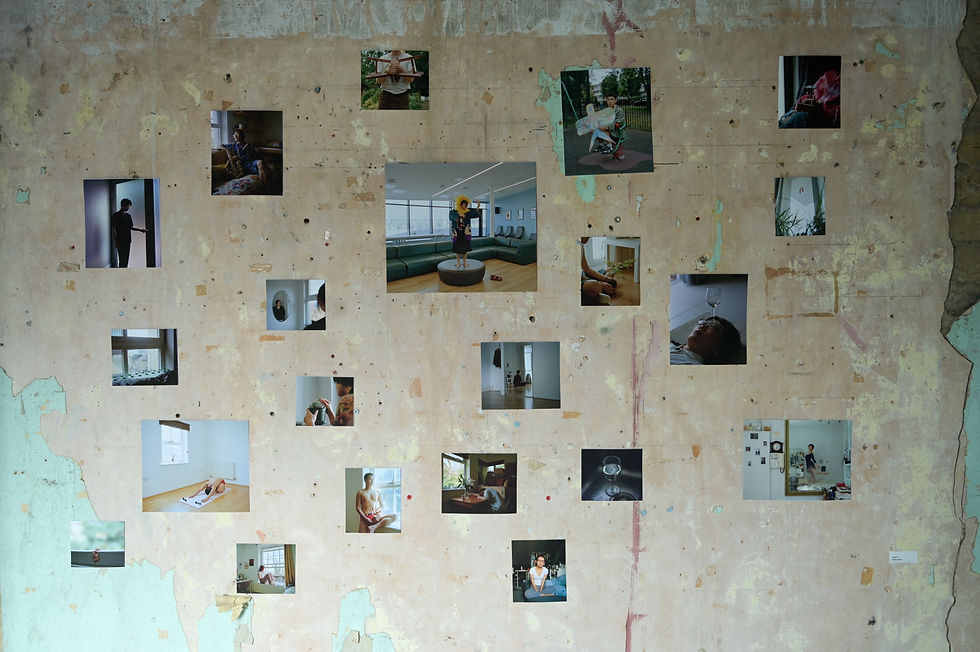
Meanwhile Yulai’s shots of people getting on with things – some silly, others innocuous – represent a certain comfort people revel in when totally absorbed within the safety of home. I just like how both artists have decorated the space with mementos as if they live here.

The more time I spent floating around this house the more it became apparent how every scratch, stain, stink, and deformity of Safehouse 2 has been totally consumed by the show’s conceptual message. As an art space, the signs of previous usage are clear in the picture hooks and hanging wire that weren’t removed from last time. Doodles and graffiti mark every conceivable wall like the album cover of Beggar’s Banquet. This ever-changing structure that threatens to cave in at any moment breaths the soul of this exhibition.

I was on my way downstairs for another drink when I spotted a type-written poem called Blunt Objects by Lu Zeng stuck to the wall. I was left with this fizzing feeling that once something essential and vital leaves your life, even the most harmless things take on a malicious air. I will proceed to copy out this poem in full to pad out the word count of this piece. Screw you if you have a problem with that.
He said dull blades are more dangerous
Because they slip harder.
So he sharpened every knife
Before he left me life
As I stood alone in the kitchen,
Performing one slice after another,
His image went dull,
And so did the knives.
From a shadow I couldn’t escape,
His warning came alive:
The cleaver cut my finger,
The bedsheet grazed my skin,
The table bruised my knee,
The toothbrush bled my gums.
Surrounded by blunt objects,
I was attached relentlessly,
In a house that once,
Belonged to me.

I wandered into the kitchen to find a table lined with a paisley cloth of white silk. Strewn all over its surface were shards of ceramic plates, their glazing shining under the yellow spotlight. These sharp hazards were placed as if in supplication around a few bowls still intact. Egg noodles in one plate, rice in a bowl, and soy sauce and rice vinegar in small dipping pots. Also on the table was a ring-bound booklet that read “Archive of Recipes”. Yufei Lucía Jiang’s installation and workshop (which I also missed…) seeks to evoke the ancestral belonging that gets passed down through recipes. I’m reminded of my own mother and the various Pakistani recipes she’s taught me that have helped me reconnect with my culture on my own terms. The kitchen, then, becomes a site where different generations and places collapse into one delectable labour of love.

I’m in the back room upstairs, looking out the window onto Copeland Park, a pristine industrial-estate-turned-gentrified-hang-out which looks pristine and untouched compared to this blasted and brilliant home. I almost walk right through a see-through fabric suspended by its corners using strings. There an image of a door rendered ghostly and half-dissolving by the fabric’s mesh. Anqi Lin’s mysterious doorway to everywhere reminds me of something I was told long ago. Some people believe in ghosts. Others believe ghosts can move through walls and glide up stairs that are no longer there because they’re simply following their routes according to the floorplan of the house when they were alive. Even if the house has been rebuilt and reshaped, they’ll continue their spectral routine without fail. Structures out of time fallen out of sync.
The longer I stared at this sheet, the more porous I felt, as if my outline were fading. I couldn’t help but feel like a ghost amongst a company of others, haunting this house aimlessly, looking for a flash of home, long long away from it yet unable to be any closer.


Comments