


Exhibition Testimony #9: The Hari Art Prize 2025

Updated: Nov 18, 2025
Images by Gillies Semple @studio_adamson
November 9th, 2025. 7:57pm. Somewhere on the M4.
I’m trapped on this coach, fantasising about how much nicer this journey would’ve been on a train. Not enough room for someone who’s 80% leg. A tremendous rain is crashing upon the windows like angry waves against a rickety boat. The windscreen wipers swing and struggle frantically. I’m envious of the person whose cheese and onion crisps I can smell as I finished all my snacks hours ago.
Without the energy for anything else, I begin to dissociate. A torrent of memories, worries, hopes, and randomness - more insistent than the rain outside - begins to pour over me. I finally manage to hold onto something in this shower of thoughts but am swept away like a person along with their umbrella in a storm. Desperately holding on, because letting go would mean falling back down to the stultifying boredom of this coach journey, I let it carry me all the way. My mind arrives at recollections of installing the shortlist exhibition of The Hari Art Prize 2025 and I realise that my surroundings have undergone a complete transformation despite looking exactly as I left them.
I did this last year so now I’m doing it again because I’m a creature of extreme habit. I’ve always been most interested in the works of artists fairly early on in their careers. Whether they’re destined for greatness or not, I’m still witnessing the genesis of something. This is the second time The Hari Art Prize has allowed me to take the pulse of an art world due a routine checkup… by none other than me! Curated by Ryan Monro, the set up is the same as last year; the twenty shortlisted artists have their works exhibited in the perfumed lobby of The Hari Hotel for the public to behold. And as I gaze upon this thin yet potent cross-section of artists, I’m left feeling giddy about all the art that’s out there and wistful for all that I won’t get to see.

I want to luxuriate in the scene out the window but it’s sprayed by a sheet of rainfall so thick that all I see is the luminous flickering of a half-blind world. Denied a look at the vista outside, my inflamed imagination is encouraged inwards. I’d draw you a map of my inner geography but I’m a bad cartographer. However, artist Anna Curzon Price isn’t.
Her paintings are populated by bizarre, introspective visions of the kind you see when staring at the sun through closed eyes for a very long time. In seeking to depict the imprint the external world leaves on the internal one, all sense of direction is obscured. A compass would spin out of control in there. With a hand both soft and unrestrained, Anna suspends us in a boundless expanse where up and down are the same, boundaries melt at will, and form fuses into each other. The vulnerably nude figures are human enough to be unsettling, with eyes pulsing profound uncertainty. Their distorted proportions are apt representations of how one’s emotions and psyche never conform to the apparent order of their bodies.
Her submission to the art prize is called Till the end of days – red and green, a scene that swirls to the command of a leaping arc. A ghostly shroud lingers towards a glowing doorway, apprehensive over the destination but unable to resist. Meanwhile a bruised figure is caught by their leg in some tremendous upheaval that threatens to infect the rest of the composition. Frenetic strokes of oil paint screams through a soft watercolour mist, like feelings that refuse to leave us alone. Spurred by the death of a loved one, this series explores the pieces we carry of people even after they’re gone. Nothing exists in a vacuum. The ethereal realm of the soul is constantly shifted by external stimuli and the emotions they elicit make us influence the world accordingly. Anna’s paintings, thus, give voice to the terror and treasure of our inner selves unable to hold their shape.

Susanne Baumann’s works are similarly driven by the presence of one’s absence. Her paintings feel like random details from some haunting scene. Despite the obvious torment of what’s happening, your brain can’t help but fixate on the oppressive softness of the lighting or the ruffles in some fabric or the way fallen leaves rest against a shoe. Her father’s battle with Alzheimer’s has made melancholia her unshakeable companion as she longs for those facets of him that are no longer or barely there. This sorrow hums like a dirge through the scenes she paints, depicting the remnants of a loved one who’s there, but not in their entirety. Whether physically, mentally, or emotionally. Hence why almost all her paintings are set indoors and heavily feature clothing and fabrics. We occupy spaces and garments like a skin, leaving a palpable mark on them. Interestingly, Susanne inverts Anna Curzon Price’s exploration of the impression the world leaves on us. Shirts, trousers, gloves, shoes, etc, exude the manic urgency in which they were discarded, leaving us to imagine the circumstances of their shedding.
In Your soul lingers in the folds softly kissed by the rising sun, her submission to the art prize, an empty and unmade bed yearns for its former sleeper. This lamentable still, just like the rest of her works, is rendered with near-photorealistic precision. Through her expressive shading and manipulation of oils, every single fold and crease in the blanket bulges and flows as if something is still underneath. But the tender light of dawn cuts through the gloom with bad tidings. While looking at this, I felt a regret so deep and wide that a ship could be sailed through it.

Similarly paradoxical sentiments are reflected in Wink K. Moe’s ceramic vases. Wheel-thrown and shaped in enticingly bulbous forms, she paints upon them vivid (usually floral) patterns in a fluid and free hand. It seems her painterly nature can’t be confined to a canvas. These are objects of stupendous beauty yet they’re constantly searching for something. “A vessel can hold space, but it can also become the space itself,” Wink tell me and I can’t help but imagine a person suffering from dementia occupying space in a similar manner. Her vases may sit sedately upon a shelf or a table but patterns splay their surface with acrobatic restlessness. In their appearance and general vibe, they’re neither here nor there. A confluence of cultures and aesthetics. Out of her many vases, the one that got shortlisted was At Sea in Dense Fog (I), this curvaceously round receptacle that pinches shut as tight as the lips of one who can speak no evil. Against its pale-yellow surface, Wink has painted these fiery flowers whose petals flick out explosively. It feels like witnessing a field full of proteas in full bloom. The pairing of paint and clay is especially salient because these mediums have a body that mirror the natural world. “They can be soft, fluid, stubborn, unpredictable,” says Wink. With the materials in harmony with what she’s depicting, these objects simultaneously belong while also wanting to regress back to their primal states of clay, pigments, soil, and seed.

Born from a comparable shakiness of one’s place in the world are the devilishly simplistic sculptures of Monica Tong. Her Lost Paradise series, these delicate bubbles of glass look very unassuming at first, until you get up close and discover what’s inside. Like a ship in a bottle, she’s constructed these elaborately tiny landscapes which look like extraterrestrial flora. Thin shavings of porcelain twirl and dance like petals and stalks out of bed of glittering stones. The whole thing is put together with the steady hand of a surgeon and it appears so ephemeral that I feared it might crack if I looked at it wrong.

A year into the COVID-19 lockdown, Monica gathered artefacts from the time when the world was healthy and open; trinkets from her travels and leftovers from projects during her first year at the RCA. Reshaping these fragments into a utopian scene encased within a glass-blown teardrop is a tender act of diarising. A living scrapbook as fragile as the memories themselves. Such a demonstration of intricate skill that one wouldn’t think she was in corporate finance for 8 years before becoming an artist. Susanne Baumann, in fact, also pivoted from a decade of project management to the arts. These sculptures don’t present their strange fruit; you must go looking for them. Craning your neck way this way and that, peering through the holes in the gossamer glass, you must study the thing from all its angles like some tangle of emotions before it makes sense.

Magdalena Gluszak-Holeksa hails from a mountain town in the south of Poland. Its remoteness and its tourism are paradoxically balanced. Time moves very differently up there. Impermanence is hardwired into her vision. This, I believe, accounts for the drift in her brushstrokes, as if the very image is being carried away by forces beyond her control. Most of her works are rendered in deep and velvety hues of green, blue, and purple. Submerged in such cryptically nocturnal colours, these scenes look like they’re unfolding at the twilit bottom of the ocean. But form and perspective are utterly skewed by Magdalena’s melting brushstrokes through which I feel the cold passage of time. Their sinister texture comes from her magical blending of lights and colour. The effect is so vivid that the only composition in which earthy brown is the dominant colour feels as if you’re gasping for air on some coast. Some of her settings have the uncanny intimacy of somewhere domestic. Her submission to the art prize, a Still life with a dried plant, is in such a scenario. A woman sits pensively, a dried-up sprig hanging from her gracefully beautiful fingers. Ripples flow around her as if she’s a memory thrown like a stone into the pond of grief. A lot of her other pieces unfold as if on the edge of some bizarre landscape. Across such sweeping scales, the sublime weirdness of her imagery reverberates like a shout from the peak of some silent mountain. Yet there’s an interiority to these vistas where their topography unfolds like the architecture of a room. Inorganic suddenly seems natural.
Magdalena and painter Cassie Vaughn are fellows in that they’re both explorers of how places unfold and transform through time. They both capture temporal drift by distilling long streams of existence into a single droplet that drenches the canvas. Cassie sees “painting as an act of excavation and discovery similar to archaeology.” This relationship is immediately apparent in the sweeping rhythm of her brush, as if she’s dusting away the ages that have passed through a place. What she’s unearthing is the present, the accumulation of every moment that preceded it; footprints in a path well-trodden. Her colour palette captures many aspects of the natural environment in all its wildest moods. It doesn’t take long for the vibrating contours of the environment to emerge from what at first appear simply as energetic patches of colour and sweeps.

Mountains (Echo) is her submission which deposits us at the foot of some curving peak blanketed in glorious sunlight. The eyes follow the outlines from one form to another as if trying to decipher some inscription graven into ancient rock. Her studious hand depicts the overwhelming joy of losing oneself in the divinity of Nature. When a sudden yet flyingly brief awareness of every moment that has led up till now roots one back to the present moment. Entire unwritten histories are told in the inescapability of a single instant. Such a need to chronicle the transformation of the natural world interrogates how much of that change is down to us – especially when it’s usually destructively exploitative. Against the grand scale of our species’ existence on this planet, modern humans take up the smallest interval of time yet have enacted unrecognisable change; for good or ill… After a methodical accretion of paint while the canvas is lying flat on the floor, Cassie hangs it upon a wall and applies the final layers in a frenzied waltz. This gestural crescendo, for me, represents that narrow slice of history during which we’ve performed so much cosmetic surgery on the world.
Like an airplane poking through that dense ceiling of clouds where the weather happens, the coach made it out of the rain and I could finally look out the window. A velvety grey sky swept into vision and stretched upwards for what looked like an eternity. A countryside, soaked in sweetness and exploding in green, was rolling past but my eyes couldn’t hold onto any detail for too long before it was out of sight forever. The speed-freak velocity of this vehicle, licking up white lines off the motorway, rendered the passing scene in a restless blur as if it was late for something. I reassured myself that not everything has to be seen by thinking of how many of the artists in the show seek the capture that which passes us by without a second thought.

When I thought of sculptor Franklin Collins’ work, I became starkly aware of my surroundings. The cold glass of the window against my forehead. The fatiguing leather of the seat. The clicking of the cheap plastic tray table. The arm rest. The narrow aisle where innumerable shuffling footsteps have worn down the middle more than the edges. The charging port and the incalculable devices it's juiced up. Frank’s practice asks, “Who else has been where you’ve been and done what you’ve done?” My initial reaction is, ewwww germs! but once the kneejerk neat-nausea wears off, I’m left feeling an odd sense of oneness. Think of the Bronze of St. Peter in his Basilica or the bronze tomb of Victor Noir in the Pere Lachaise. The fact that Peter’s right foot and Victor’s crotch and lips have been polished down by the fervent touch of countless people points to a ritual intimacy that binds millions. This same intimacy pollinates all around us every day. We swarm through the days without paying much mind to our interactions with the minutiae of the world. In our frantic absence we rarely feel the hand railings we hold onto, the walls we lean against, or the surfaces on which we bear our weight. Frank’s sculptures make conscious rather than incidental opportunities for this togetherness by indenting human presence into them.
Two hands dig and drag, leaving their imprint in a sturdy block of ash wood. The path travelled by the fingers is chiselled in the wood, a material Frank often works with. In this piece, Gather, he invites you to leave your trace where others also have. Such a considered interaction with an object slows down something that’s usually fleeting as we witness absence turn into presence.

Grace McNerney is also investigating our transient relationship with things, especially artefacts from previous generations that become suspended in time while the rest of the world moves too fast around them. This sensibility creeps into her paintings as niche pop-cultural imagery from a bygone era, the kind you’d find in a flea market, charity shop, or estate sale. Like some curious find from the bottom of a dusty basket, there’s something odd about her scenes that you can’t quite place. Maybe it’s the soft outlines that lend them the appearance of a memory preparing to fade - a feat executed by a deft hand at blending. Or perhaps it’s how unremarkably plain settings are invaded by a sudden ambush of weirdness. A butcher playing the bass to an audience of pig carcases is my personal favourite. Through the means of a split frame or by unapologetically sticking smaller frames of different scenes in the larger work, Grace creates curiously silly juxtaposition that totally shatters your suspension of disbelief. It’s the brainrot we desperately need! With the lifecycle of a trend fast diminishing in an era where multiple generations of digital natives inhabit the internet, her practice is refreshingly anachronistic. The scenarios and people of her paintings capture the mundanity of the era they’ve been sliced out of while being soaked in the irony of a present that has lost its bearings.
Her contribution to the art prize is an upcycled rug from her family home which she’s transformed into an altar piece similar to the rest of her paintings. Two deer lay dead; their entrails and organs placed thoughtfully around a bleeding heart in the middle that bursts with sacredness. It’s symmetrical enough to look like a playing card. Fawning feels like giving a ceremonial burial to roadkill. Painted in her dreamily unfocussed hand, the colour of the deers’ pelt and organs are weaved into that of the rug so perfectly that you’d think it came out the carpet store this way. Look carefully and you’ll see the deer fading as the intricate patterns of the fabric peek through. Through this ritual, these deer are graced with the dignity of quietly fading away rather than putrefying messily all over this pretty rug.
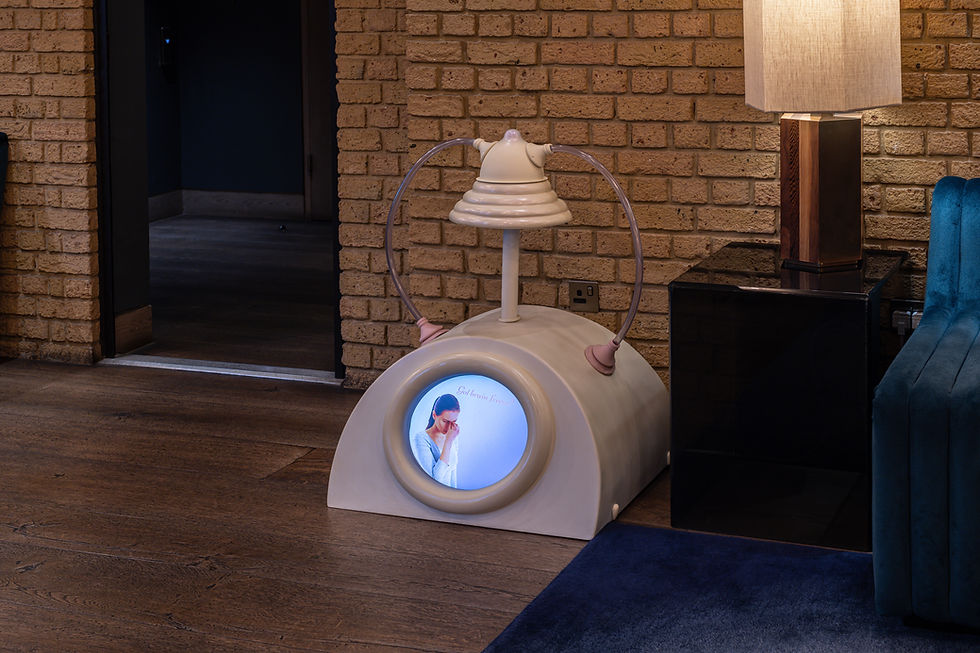
Much like Grace, Laura Kazaroff uses kitschy brainrot in some of her works to demonstrate disposability; focussing heavily on how it exists in our language. Calling Laura a sculptor would be selling her short; she’s in fact an inventor. In a subterranean lab that’s well-lit and devoid of sharp corners, she’s engineering bizarre devices that will surely put psychiatrists, therapists, and psychologists out of work. You might be nonplussed by their pastel appearance, bizarrely alien shapes, and strange pipes connecting to even stranger chambers. Some of her innovative contraptions include a ‘vibe check’ machine, a magic ‘it is what it is' wand that fixes all your problems, and – her work in this show – a contraption that will unleash your true potential.
This cross between an alarm clock and a defibrillator has a screen on its face that showers you with positive affirmations to get you through your day. “I choose to be happy”, “I live my highest potential and truth 24/7”, or “The biggest choices end & begin with me” are but some of the messages that flash on the screen. Cursed fonts, stale stock images, and lurid word art makes the imagery as mindless as the messages themselves. This piece is situated in a wider context of questioning how certain cheap therapy phrases are overused to the extent of obsolescence. This same strain of overuse skews the meaning of psychological terms such as narcissist, lovebombing, trauma dumping, etc; terms that have entered our vernacular. Her use of found objects in sculptures that are entirely surface-gloss is then an apt visual metaphor for how language gets repurposed while our mental health is being commodified.

Where language moves at the speed of sound, information moves at the speed of light and Rita Osipova is left wondering how the puny human mind can cope against something that moves at the cosmic speed limit. Her multidisciplinary practice takes stock of how perception and emotion are influenced by information and digital culture, how the world is developing faster than our senses can keep up. A fountain made out of cables or a pool ladder which unfurls into a tangled snake of wires represent her vision of a world where technology has grotesquely outpaced natural selection. But her submission to the art prize points to the more tender side of her practice. Though diminutive in size, Held Absence is mighty in effect. Rita’s grandmother used to love narcissuses. As an act of remembrance, the shape of the flower is moulded into the surface of industrial materials as weighty as the memory itself. Senses degrade and memories fade overtime, so Rita’s desire to enshrine this one aspect of her grandmother depicts humanity’s desperate determination to commemorate love and beauty. How the bulging form of the narcissus disrupts the regimental lines of the corrugated metal is a salient reminder that memory and emotion always prevails over the synthetic and virtual.

Tinaye Makuyana calls herself the girl who paints with light, and I wholeheartedly agree with her. Bottling up this fleeting illumination, she makes it the primary medium of her work, alongside… paper. Plain and simple paper. Art supplies are expensive. But paper is so abundant that we’re sometimes blind to its existence. By scoring, cutting, and folding it, she structures the surface to catch light. At first glance the blazing contrast between the paper and the hot spillage of colour might suggest she’s using LEDs or other artificial lights, but no! The effect is entirely optical. The contours of the paper funnel light through a richly coloured surface out of sight, where it ricochets back onto a sea of white. At times her works look like luminous blood spurting from a wound.
Gratuitously violent metaphors aside, Tinaye’s submission to the art prize, Under the Rainbow, yearns for simpler, more innocent times. Very valid given the geopolitical shit-storm we’re living through. A triangular fold in the paper gently cups the light and imbues it with the soft, echoing hum of a rainbow. There’s one now, unwrapping across the sky outside the coach window as shafts of sunlight squirm through the clouds. Such calm colours settling on the quilted texture of Tinaye’s paper take me back to moments of utter breathless curiosity. When beams of light pass through a glass of water or staring into a lamp through rain-soaked glasses, when one becomes totally mesmerised by something ever-present that makes its existence known for a fleeting instant.
As this tin-box carried me through vast open country, I spotted all manner of cattle grazing across the land. Watching the horses, cows, and sheep in wonder, my mind turned towards the recurrent appearance of animals through the work of some of the artists here.

As a child bored out of my mind, I often used to chase chickens in the scorching Pakistani countryside. Those fuckers can really sprint but once you catch one they docilely let you carry them as if their survival instincts were exhausted by the run. Satisfied with the triumph, I’d leave the little bird alone and go about my day with a song in my mouth. I recall such times while wondering at Claudia Pons Bohman’s paintings in which chickens turn up often. She’s particularly sensitive to what exists beyond life; not necessarily after death but that which can be felt though not seen. It might be the presence of someone dearly departed, the sinking déjà vu of a dream, or memories reaching out from the past. This is the world she’s expressing in her work, one that’s still loosely tethered to ours but where things unfold with an incomprehensible magic. When the sun shines there, a carnival of blues and greens burst off the canvas like exploding crystals. And when it rains, it pours; the hues becoming pale and miserable as the outlines that gave them form get washed away. But in either climate, Claudia’s passionate brushstrokes descend like a veil separating this world from ours. Then there are the chickens. Many cultures believe in birds as messengers between realms, but chickens don’t fly! Whether present or hiding in plain sight, the theatrical blocking of her compositions reveal them as alluring creatures pondering their next mischief.
In Uno de mis sueños, a chicken with a particularly fetching plumage stares as its own feet digging into the warm earth, its feathers blending frantically into the foliage behind. The scene is awash with the ticklish awkwardness of the chicken not wanting to be witnessed in this situation. The fluid texture of the piece flickers through thick and thin dabs of paint dancing all over the place. I adore the humour in her pieces as it feels like watching a bird crossing the road, opting to walk rather than fly. But I guess there’s a reason why chickens are popular pedestrians…

Apparently, Emily Hoyle once flirted with the idea of becoming a vet but her heart really belonged to the arts. Yet the compassion of a caregiver radiates from her lucid and assiduous portrayals of countryside animals. She describes herself as embodying classical aesthetics with a contemporary sensibility, and this is strikingly clear through a style that swells like modern orchestral music. Throughout her corpus, grand moments of voluptuous photorealism are counterpoised by these quiet, contemplative sketches where the essence of her subjects turns into mist like winter’s breath. The brevity of expression in her pieces matches her own eloquence; an attribute perfectly reflected in her submission, Jockey in Pink.
The stolid figure standing there stares off into the incomplete vastness of the linen onto which he’s painted. Without his horse he’s at a loss and the rest of the world might as well not exist. He wants nothing to do with us until his animal returns. Wanting to get past his cold shoulder, the eyes have no choice but to linger on his every detail like precious words silently spoken. Emily’s understanding of anatomical proportion, the surgical precision of her marks, and the restrained use of lighting rivals that of the Old Masters. The figure emerges out of the blankness like an idea fully formed from its inception. Depicting this horseless jockey is a playful inversion of the love affair art history has with horses. They turn up time and time again. Just not in this piece.
Been staring through this window so long that I’m no longer sure whether I’m in or outside. The open road seems to have that effect. I’m having a hard time imagining how the landscape out there looked hundreds of years ago when the air was cleaner and the world span slower. Are those trees less happy now that they have to stare at cars endlessly zooming down six lanes of asphalt? Or do they appreciate the minuscule snatches of passing company adding up to a lifetime of companionship? So far out on the road, away from all the noise, it occurs to me that sometimes the present feels more fictitious than the past and future. And I think some of the artists in this show are aware of this.
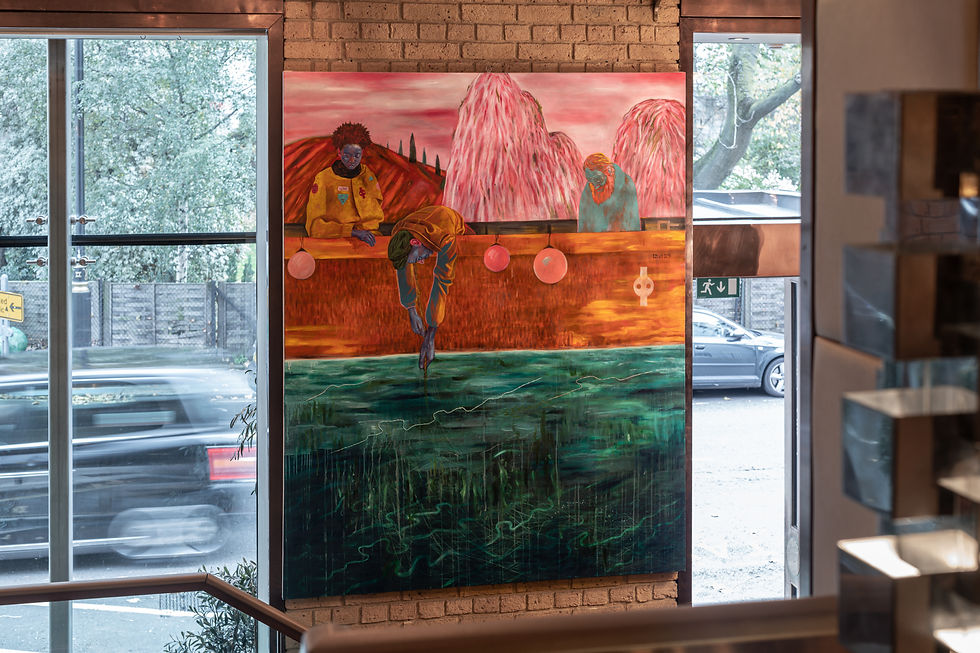
Damien Cifelli, for example, who with the zeal of a scientist disembarking on alien shores explores and documents a world of his own creation. He calls it fictional anthropology. Through hallucinatory paintings he’s mapping together the geography, history, and societies of a world called Tarogramma. The sky is the colour of your brain. Liquid emeralds flow through its valleys. The environs are bountiful in flora and fauna of the kind that perplexes the imagination. Yet the people, apart from their marvellously coloured faces that shine metallically, aren’t too dissimilar from us. They seem to loiter and stagger around with a ritual aimlessness that many of us know all too well. Without any chronology and separated by vast tracts of distance and time, Damien’s resplendent paintings are developing a world rich with its own customs, logic, and lore.
Take Dredge Subwending, for instance; currently a window between Tarogramma and The Hari Hotel. The harmonious misery of the three figures hunched over this bridge is the same collective burden their fellow people seem to carry. Everyone seems to be peacefully atoning for something. Like most of his work, a feverishly psychedelic colour palette is communicated through a fluster of evocative brushstrokes pregnant with ambiguity. With the meagre scraps of familiarity Damien permits us, we’re invited to historicise this fictional place. Or as he’s put it more eloquently that me, “Any reality is just scaffolding for the imaginary.”

Katie Tomlinson understands this intimately well as her imagined panoramas keep reality at arm’s length. The benevolent strangeness of the happenings in her canvases reflect the surreal beauty of a world seen through a queer, feminist, and neurodivergent lens. The symbiosis of her identity and artistic vision swirls into these viscerally textured paintings where the colours sing in a marvellous falsetto. A perception that feels reality with all its force is behind these tableaux of grotesque horrors and mystical explorations. Form is often pulverised into a nauseating slop that you can’t turn your eyes away from. In such a visual arena does she tackle how femme bodies are governed in a largely patriarchal and heteronormative society. Her fiction locks eyes with the real to call it out.
Funnily enough, her submission to the art prize this year - I Want Money, Power, and Glory – is in the exact same spot as her piece from last year’s exhibition. That’s turning into her spot now. Note to every artist out there; the best way to win me over is to have a cat in your work. It’s a testament to her abilities that I want to pet the cats in this painting despite knowing that I’ll lose a hand. The pastry display which they’ve invaded is rendered in delectable hues that’ll make you salivate on an empty stomach. There’s a murderous comedy to the victim’s hand prints and the victorious fire dancing away in the back. One can’t help but make a connection between this scene and the avarice of powerful losers who’re fuelling the current global downward-spiral.

Once the people hell-bent on looting and burning the pastry displays of the world get in power, they aim to stay there until they drop. Throughout his upbringing in Madeira, Rodrigues Goncalves has been cogently aware of the structures that keep these fuckers at the helm. Reverberations of Estado Novo Dictatorship in Portugal manifested as unspoken systems of power embedded in the very fabric of society. A strong iconography is the STD through which a regime (whether imperial or dictatorial) spreads its message; symptoms of which linger long after the oppression is over. They find their expression not just through the classical means of architecture, religion, and social norms but through the less obvious avenues of branding, advertising, and celebrity culture too. Appreciator of chickens, just like Claudia Pons Bohman, his sculptural practice humorously reappropriates these symbols to expose how they’re used to influence thoughts and beliefs.
Once you get past the startling irony of a cannabis plant growing out of a neo-classical Wedgwood jasperware vase, the layers of interpretation in Propagation present themselves like a Christmas trifle. Thorn in the side of the authorities; a countercultural symbol; and thought to be a means of spiritual awakening; weed is but one of the many images whose cultural status has shifted through time. But through a process of accretion rather than replacement, these objects maintain all the former ways they’ve been perceived by society. His submission to the art prize, just like his other sculptures feel like a tense web of scathing irony as they emphasise the overlaps between all these visual associations. The sardonic ambivalence of his pieces encourages one to defy the calculated certainty that power structures depend on for sustenance.

Both Rodrigues and Beth McAlester demonstrate how truth can turn into fiction under duress, how politics can seep into the tapestry of society; except she does it through semi-biographical narratives rather than iconography. Growing up in Northern Ireland, the place has clearly impressed itself on her artistic vision. The air is thick with a gloomy melancholy in her scenes of the countryside, held together by these washed-out brushstrokes and dissolving blends that seem to be resisting external influences. This, to me, is representative of Beth’s contradictory position as an Irish artist working in English institutions in a way that places her within and against it. Another contradiction defines her Ceasefire Babies series from which her submission to the art prize comes from. This ever-growing collection of tiny paintings – mostly portraits of babies but some of random objects – are vignettes of lives following the aftermath of the Troubles. All of them are painted on wood, but some of them are literally the grain and texture of wood painted photorealistically onto the panel in an act of playful facsimile. The sepia tones and hazy lighting of these portraits give them the air of snippets from a family album unearthed after decades. Her painstaking act of documentary exists fluidly between fact and fiction, but it’s no less real. Currently exhibiting in The Hari is the first one of the series, F*ni*n B*st*rd G*rry Ad*ms, another baby portrait but this one’s been defaced with a moustache and glasses. Though the subjects in this series have no idea of the uneasy peace that protects them, Beth’s brush goes a long way to express it. And her vandalism of such innocuous scenes reveals the interconnectedness of violence and humour. In fact, humour is essential in getting over violence.
Reaching new depths of boredom, I start people watching in the coach. The person snoring next to me. The couple holding hands across the aisle because they couldn’t get a seat together. The person with a window seat defiantly doomscrolling instead. A lot of bodies in here; each of them a universe in their own right but ultimately contained within a delicate meat-suit. A well-placed cut on the inner thigh is all it takes to bleed out in minutes. Perhaps it’s best not to remind them of their own fragility. I’ll leave that task up to the remaining artists who seek to question the cultures that surround, mould, and define the body.

There’s no doubt as to the messiness of humans. Physically, emotionally, and spiritually we’re all over the place. Each day we make a conscious decision to ruin or make someone’s day. We’re attracted to the abject, compelled by carnal desires, and ruled by inexpressible fears. Elinor Haynes has made it her mission to capture the sublime pandemonium of human behaviour by instilling her sculptures with chaotic attributes. The grotesque assemblage of glass, wood, ceramic, wax, bone, and animal skin gives these pieces the appearance of objects mined out of unhallowed ground. Guided by an inconceivable imagination, Elinor contorts these materials into forms that are equal parts nightmarish and irresistible. This is magnificently at odds with conditions of a society that seeks to homogenise and clean its people. We’d rather revel in the mess, thank you very much.
In her spectacular submission, Drowning, wood and glass are entwined in a deathly dance. Glass flows through the air like glittering water, swirling and wrapping around wooden limbs to form something of a vessel. About a pint of water is held in it which is bubbling weakly via a tube attached to a pump. I felt short of breath and mesmerised by this thing, imagining the thrashings of something fighting for air. Only a pinnacle of material manipulation could’ve created this, evident in the elegant glassblowing and the stressed-out wood. Following the contours of this eternally mutating thing, I was struck by the overwhelming tangibility of being alive, all the natural processes unfolding inside of me, and how it really doesn’t take much to stop them. After some time, the water evaporates and this poor soul can finally breathe again... until one of the hotel staff refills the vessel.

As we move from the deformed ooze of Elinor’s sculptures to Celia Mora’s paintings, a more recognisably human form emerges from a dreamlike haze. Her depiction of the body is a tender celebration of beauty and vulnerability. Using her partner as male model, she breathes to life these moments that feel candid and ephemeral, even if they’re staged. As the artist, Celia taps into the mutual trust with her partner to have complete control over her representation of him. Subverting the historically male-painter/female-model relationship, her scenes invite rather than invade - seeing the person rather than the body. Balancing her contemporary intentions to explore gender, perception, and power are her Baroque influences. Oil paint is applied thin and layered in a meditation of marks where figuration blossoms peacefully out of abstraction. Hence the timeless look of her paintings which share the same classical-contemporary sensibilities of Emily Hoyle’s works.
A male figure lays on his side towards us – though we don’t see his face, we can work out much about him through the floral sheet draped sensually around him. The joyful sky appears glad to be witnessing this. Odalisque, her submission to the prize, is an exemplar of her techniques where the gradual accumulation of paint applied with a silken hand creates an introspectively beautiful vision. Around this person are decadently ornate vessels such as glasses, bottles, and pots; a recurring motif in her recent work. Reflecting the bodily form through their polished surfaces, Celia’s suggestions of corporeal insecurity aren’t too dissimilar from Elinor Haynes’. Like a glass tipped off a table, knowing that our sense of self can so easily shatter is what should encourage us to hold no one belief or state sacred. Because an avalanche of newness is always raging down the mountains of life.

Brianna Lois Parker’s practice is a stunningly charming compilation of Black culture in London. The people in her paintings radiate an infectious confidence that invites you to belong in the scene with them. Her love of depicting the people, places, and rituals of the Black community go hand in hand with her anatomical description where even the blankest facial expressions or the simplest actions convey the full weight of the person’s existence. Dressed in the heights of street fashion and glittering with jewellery, the mix of figuration and still life gives these people an antique majesty even if they’re spiking water with Wray and Nephew, bedrotting, refusing to pass the AUX, or munching on some Morley’s. And her painterly abilities have only gotten more expressive with time as her recent works whisper surreal nothings. In her recent paintings, intense decorative detail finds its counterpart in atonal and odd shading that sheds an uncanny vibe on her scenes.
Such as Bending Over Backwards, her vibrant submission that rings the melodious bells of a new series she’s developing. A man in black shorts is suspended in a filmy sea of pink. Curled up on himself, he’s reading All About Love by Bell Hooks, which is significant because Brianna seems to be doing some soul searching on that topic. She’s confused about the caution with which love is discussed these days; how can such an infinitely beautiful feeling be treated with such timid aversion? Through this series she wants to explore how medium and representation itself can radiate qualities of love such as commitment, care, and trust. These attributes are immediately apparent in the figure’s focussed gaze, the dynamism of his pose, and his naked vulnerability.
Traffic thickens and the ecstatic acceleration of the coach is curtailed to a bored crawl. I believe my mood has rubbed onto this vehicle. The transcendent monotony of open land gives way to a cubist array of concrete and glass. My meditations on this exhibition have seeped out of my brain and into my eyes. I must wait while I come down from this high. But in the meantime…
Frequently am I struck with the instinct that life and art imitate each other. Which is why I’m thoroughly interested in the spaces of art. What phantasmagoric communication between the works and the walls are slipping our attention? My recent haunts around the art scene have taken me into some pretty peculiar spaces and now I’m plummeting down a rabbit hole thinking about the role of the gallery. We all know the traditional white-cube space; it’s standardised and does what it says on the tin. In an ideal world the art and such a space are symbiotic; but this isn’t an ideal world. Illuminated under this light, I’ve long held the view that either the art legitimises the space or the other way round. Sounds pretty narrow now that I write this. Beth McAlester is of the opinion that though the context invariably affects the reading of the work, legitimacy doesn’t flow in one direction. “A strong piece can transform a space just as much as a powerful space can amplify a work,” she says lucidly.
I’m more interested, however, in spaces where art spontaneously appears like mycelium. Such as the attic in Anna Curzon Price’s parent’s house. Visitors to the show had to walk through the kitchen, the living room, and up the stairs to get to the space. In the same vein, Celia Mora sees the exhibition as an extension of the studio where new ideas and ways of seeing are tested. Rodrigues Goncalves, on the other hand, firmly believes that regardless of the space, the work sets the tone. He says, “The space might frame it, but it’s the art that ultimately gives it meaning.” Frank Collins agrees to the extent that he finds the word “legitimacy” odd in this context; it wouldn’t be called a gallery if it had no art to legitimise. But art, he believes, exists in and of itself. “If a work lives in a shed all its life,” Frank says articulately, “and is seen by no one except the artist, does it make it any less legit than one that’s been shown all around the world. They’ve both succeeded in changing someone’s mind whether it’s one or one thousand.” Furthermore, it’s about the empty gaps around the piece rather than the positions it occupies itself, Frank tells me. How a piece of art can colour the air around it; instilling a feeling of joy, dread, sorrow, curiosity, confusion, or all of the above. “An art work is basically one of those aroma humidifier things, jutting out a mist of feeling into the room. If the room isn’t clean or doesn’t complement the aroma, it’ll smell bad and nothing will feel legit if you’re busy plugging your nose.”
I had Frank’s words in mind when I finally got off this coach and greedily inhaled the aroma of the world, a perplexing mix of beauty and brutality. Maybe that’s why it’s so easy to become intoxicated by the artistry of existence. Despite everything that’s so wrong on this planet, the fundamental motion of the universe seems so meticulous in its chaos that one can’t resist the honour of being a part of it - however little. And that, I think, is the essential questions the artists in this show are asking; what does the space around you feel like? Are you happy with the energy around you or must you go holding your nose all the time? I’ll leave you with a line from a Pink Floyd song;
If I were a good man, I’d understand the spaces between friends.


Comments